menu   home About Me My Products  
Showing posts with label Science. Show all posts

"Learning to Read" to "Reading to Learn": Making the Transition


One of the biggest transitions that takes place in my second grade classroom is the move from learning to read to reading to learn. Throughout the school year, we continue to work on our reading and phonics skills. However, my goal for my students is that they leave the second grade with the ability to comprehend so that they can read informational text.

Upper elementary students are required to read to obtain information. Students have to be taught how to retrieve the information that they are looking for. One of the best ways to do this is to model this skill. This can be done as a whole class, small groups, or one on one.

Before you begin, make sure that your students have the supplies that they need. My students LOVE using highlighters. Yes, when they first start using them they tend to go a little overboard with the highlighters. However, once they get used to having them they use them more wisely.

Find a text that is meaningful! I would make the text relevant to something that you are covering outside of your Reading/LA block. I would use a text that relates to your current Social Studies or Science unit.

We start by reading the text together and discussing the text before we move onto the questions. If you are doing this as a whole group activity, I would definitely have the text enlarged on a projector. Once you start the questions, read the first question aloud. Allow for time before asking students where they found the answer in the text. I like to have students come and point to the sentence in which they found the answer. Then together, we all highlight the sentence that answers the question.

Then, we write down our answers. If students have more than one color highlighter I would allow them to change colors when answering different questions.

We work on this skill quite a bit in the spring as preparation for the third grade. These skills enable my second graders to be better prepared for third grade.

Looking for some FREE reading passages to use in your classroom? Check out these FREE Social Studies and Science reading passages!


Magnet Experiment FREEBIE


My kids absolutely LOVE this simple magnet experiment. I use it as a fun way to conclude my unit on force and magnets. You can find the recording sheet and instructions for the experiment here:


You will probably already have all the supplies that you need in your classroom.


Materials Needed:

·One pencil per group

·String or yarn

·Small magnets (Circle, ball, bar)

·Large and small paper clips (colored ones are more fun)

·One paper lunch bag per group

Teacher Prep

1.Construct “fishing poles” by attaching a magnet tied to a string to a pencil. The pencil serves as the pole. The string or yarn is the fishing line. The magnet is the hook.
2.Put an assortment of large and small paper clips into each paper bag (at least 20 large and 20 small in each).

Instructions for students

1.Without looking in the bag, drop the fishing line. Carefully pull up the line to see what you “Caught.”
2.Record your results and put your “Fish” back into the bag.
3.Pass the bag to the next person.
4.Continue until your charts are full. Compare results with your group members to see who is the better “Fisherman.”


Kids finish early? Copy the recording sheet double-sided and let them "fish" again!


What is a Scientist?


One of our first lessons in Science is about scientists. It comes after our lessons over Science Tools and Lab Safety. ALL of us are scientists! When students are exploring the world around them – they are scientists! In primary grades, we explore the basics of what being a scientist means. We explore the different ways that they use their body to explore the world around them. One of their favorite projects is drawing themselves as scientists.  I always draw an example of myself as an example…


Safety goggles are a MUST! Remember to dress as a scientist would dress. I also have them label their scientists to show me how they can use their bodies to explore in Science. These are always some of the first pictures that we display in the hallway for the school year.


I was especially excited to start this unit this year because I revised my entire “What is a Scientist Unit.” It is much more teacher and student friendly! You can find it in the link below.


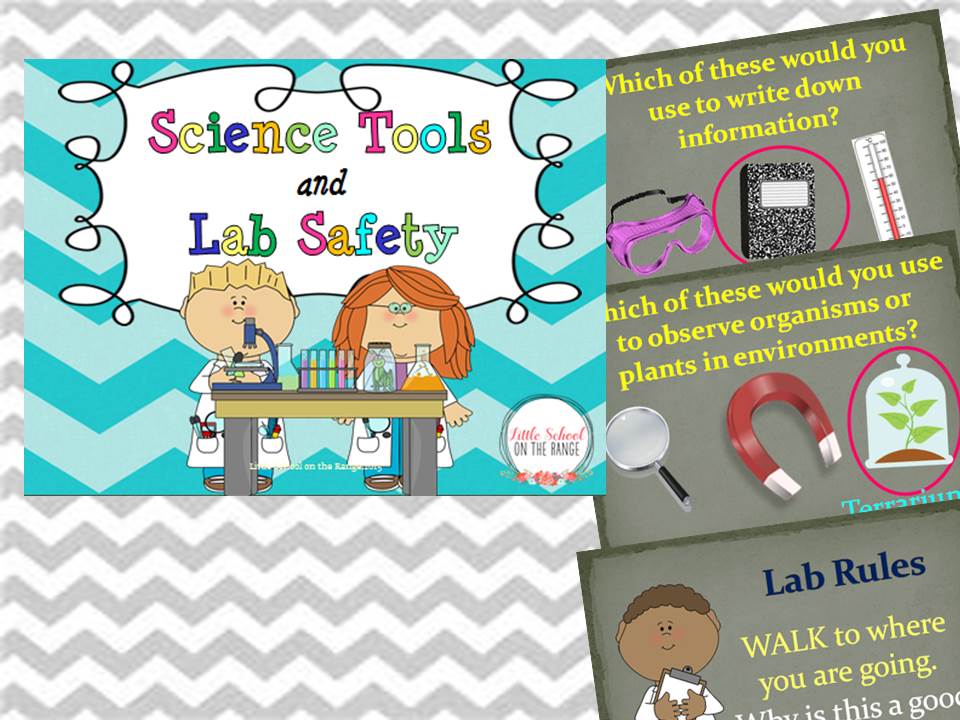
Science Tools and Lab Safety for Primary Grades


One of the first Science units that I teach every year to my kiddos is about Science Tools and Lab Safety. It is a great way to familiarize the students with the Science tools that they will be using all year long. It is also a great way to teach them how to properly use them. It is important to remember that while you may be teaching young kids, you are also laying the ground work for all the Sciences that come later. Science in the primary grades prepares students for biology, chemistry, physics, etc…Since I teach second grade, I generally stick to the basic Science tools such as:
·         Magnifying Glass
·         Magnet
·         Microscope
·         Terrarium
·         Computer
·         Balance
·         Beaker
·         Weather Vane
·         Aquarium
·         Safety Goggles
·         Notebook
·         Thermometer
·         Rain Gauge
·         Stop Watch
·         Ruler
·         Scale

I have my students cut out fact cards for the different Science tools. We put them into a pocket in our Science notebooks for reference throughout the year.

If possible, have all the tools for the students to examine. I like showing the students the real tools as well as using a Power Point presentation that encourages discussion about the reasons we use Science tools.

We also discuss which tool is the correct tool for the different jobs…

Lab Rules are also crucial to teach students. Even if you don’t have a Science lab, lab rules are important to follow when performing experiments in your classroom.

My best-selling Science Tools and Lab Safety Unit can be found below


My Science Tools and Lab Safety Presentation can be found at:


OR, you can buy the BUNDLE and SAVE!!!


Integrating Reading into Science

            Reading is a BIG part of primary grades. In order for students to be better readers, it is important that we integrate reading into ALL of our subjects. Reading and comprehending informational texts is crucial. Students have to be able to read nonfiction and obtain information. Science is an easy subject to incorporate reading. We are currently learning about the Solar System. We are reading informational texts about the different bodies in space. We are learning and practicing our reading and comprehension skills at the same time!


The samples from the picture above can be found in my “Exploring the Solar System No-Prep Unit.”

Below is a sample of one of my most downloaded FREEBIES! It comes with informational texts about the sun along with a sorting activity for the planets.


Encouraging Curiosity in Science

My boys have always been naturally curious about things in the environment. Since we live in the country, we spend a good part of our time outside and in the middle of nature. I learned when they were young that it was a cheap form of entertainment. It has also spurred on some interesting questions! I can’t count how many times my boys have seen something outside that required further research (I still encourage them to use encyclopedias, I’m old school that way).

            One of my oldest boy’s favorite memories from kindergarten was the day that his teacher decided to take the class outside after a heavy rain. Even though it was too wet to have recess on the playground, she turned their recess time into a learning experience. She gathered yarn (about 1 yard in length each) for each kid and some sandwich meat from the lunch room. She tied a small piece of the sandwich meat to the end of the strings for each kid. They then proceeded to go outside and into the ditch to teach them all how to fish for crawfish (crawdads)! I can only imagine the questions that it inspired of her kiddos. What do they eat? Where are they when it’s dry? Are they always in the ground? She even called ahead to some of the parents and let the kids take them home with them!

            Ever since that day, my son has LOVED to go crawfishing! As a matter of fact, all of my boys do. It just goes to show you how much of an impact your small lessons can have on your students.

            We spent the afternoon crawfishing today.  Is it my favorite thing to do? No. Do my kids love it? – Yes. Did we have some great conversations about animals and nature along the way? Absolutely!


            My youngest was not too interested in the fishing. He was more fascinated with the tracks in the mud made from worms and other critters. He also conducted a mini “Sink or Float” lesson off a small bridge down our road while his brothers were fishing.


            Below I have attached my Animal Habitats FREEBIE research form. It can be used for students of all ages to complete their own research on whatever animal they are curious about – enjoy!


Weather Foldables for Interactive Notebooks and Lapbooks


Interactive notebooks are an awesome way to introduce or reinforce information. These Weather foldables serve as a source of information for the students. When printed regular size, the foldables fit perfectly into notebooks.


                However, there are some times when I would rather have a lapbook for my students. Lapbooks can serve as a quick and easy reference when studying a topic. I really like them for units of study that make take more than a week to cover. We simply add a little to them each day. For instance...WEATHER!


 I have found that I can accomplish this by simply adjusting the way that I print them. It’s really easier than you think.

Step 1
Select the pages that you want to print.


Step 2
Decide how many to print per page. You may want to experiment with this to see what size works best for you.  I have found that 2 or 4 per page works really well. Any more than 4 is really just too small.


All of these weather foldables (and more) are available in my Weather Foldables for Interactive Notebooks and Journals!